Program 05 · Research lineResearch line · Not currently offered as teaching
Wound Biology, Genetics & Regenerative Medicine
Research & Educational Development: The Science of Healing and Scarring
The science behind the journey from wound to scar.
- For
- Researchers, educators and clinicians
- Curriculum
- 3 areas of inquiry · 10 topics
- Format
- Research line, no teaching format
- Academic direction
- Dr. S. Nouri Rafiee

StatusResearch line, not currently offered as teaching. It studies the science of healing and scarring, appraises the evidence on regenerative approaches critically and makes no clinical claims.
Why a research line and not a course
Every decision about a wound rests on biology: how tissue repairs itself, why adult skin usually heals with a scar rather than regenerating, and why some scars become hypertrophic or keloid. That science is an active field of research, and regenerative approaches such as platelet-rich plasma (PRP), microfat, nanofat and stem cells attract considerable interest; the strength of the evidence behind the claims made for them varies, and is itself a subject of study.
For that reason the subject is kept apart from teaching. Wound Biology, Genetics & Regenerative Medicine is a research line within the Academy’s research and educational development: a place to study, appraise and ask questions. It is not a course, it trains no one in any procedure, and it makes no clinical claims.
What the research line studies
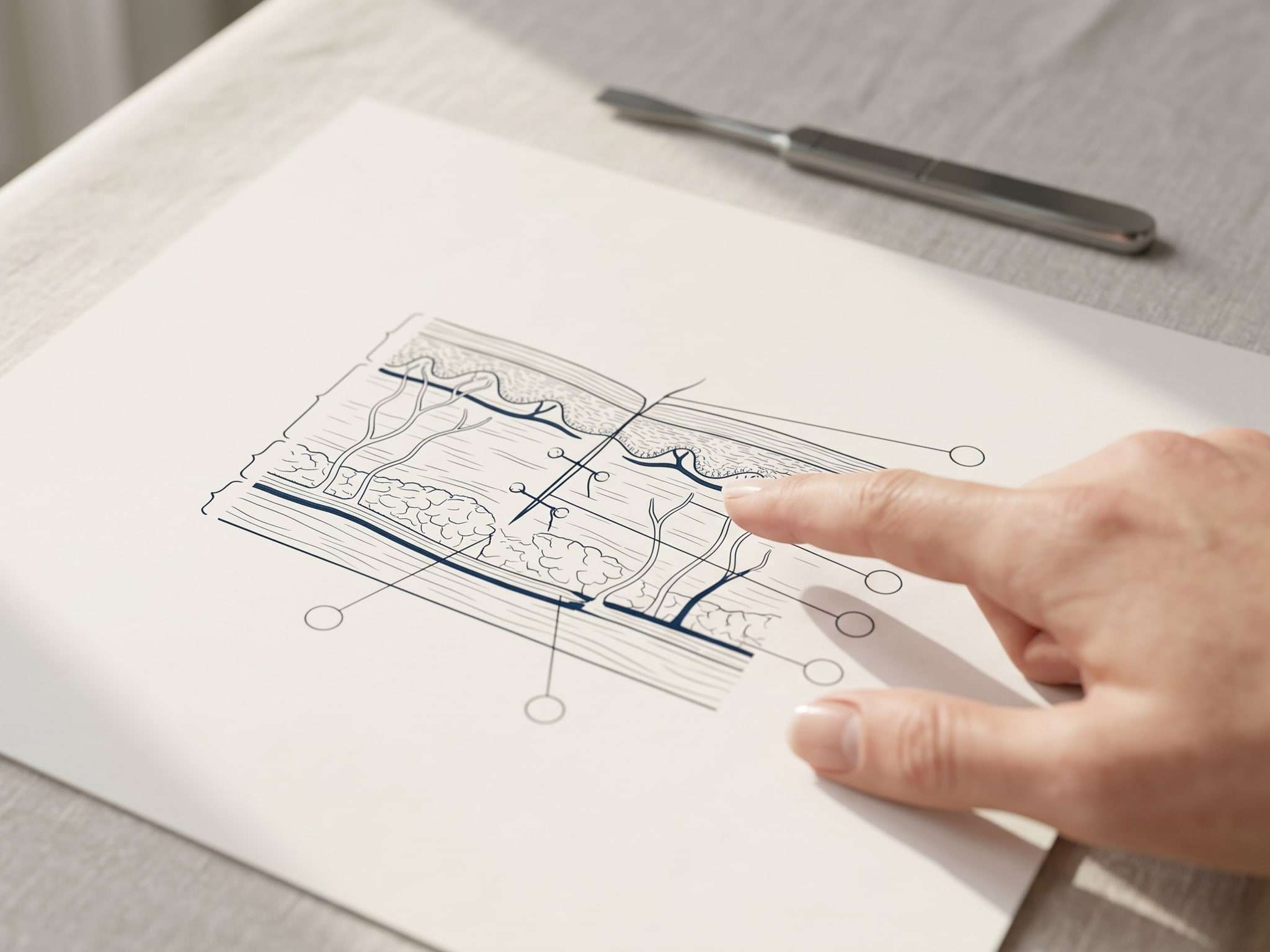
The line is organized in three areas of inquiry that move from the general to the particular. The first is the biology of healing and regeneration: the phases of wound healing, the difference between repair and true regeneration, and what regenerative medicine means as a field of research. The second asks why similar wounds leave different scars, reviewing growth factors, the genetics of wound healing and the molecular factors that influence scar formation.
The third area applies that background to specific regenerative approaches. PRP, microfat, nanofat and stem-cell research are examined as subjects of critical appraisal: what has been studied, in which settings, with what methods and with what quality of evidence. The purpose is to distinguish what is established from what is emerging and from what remains untested. Describing a study is not endorsing a treatment, and nothing here should be read as a recommendation.
How it connects to teaching
The research line is not taught, so it has no teaching format of its own. Its questions reach the teaching programs in a narrower way. Wound biology is part of the foundational-knowledge stage of the Academy’s teaching progression, and understanding of it is one of the knowledge domains of the assessment framework, itself in development. The research line is designed to keep that foundation accurate and current as the science changes.
How it relates to the other programs
The closest link is with Wound-to-Scar™, and in particular with the FOLLOW-UP phase of the Rafiee Educational Approach, where scar maturation is reviewed and the early signs of abnormal scarring are recognized and referred. The line’s critical reading of regenerative claims also bears on patient safety, the subject of Clinical Aesthetic Practice & Patient Safety, and on the honesty of the aesthetic consultation, which Aesthetic Consultation, Ethics & Practice Development is planned to develop in depth.
Current status
The research line is being defined under the academic direction of Dr. S. Nouri Rafiee. The Academy has no findings of its own in this field yet, and nothing on this page reports original results. Any findings will be published whatever they show, including results that do not favor a regenerative approach, and will be reported on the research page. Researchers and educators with an interest in wound biology or scar formation are welcome to discuss a collaboration.
Describing a study is not endorsing a treatment. The research line reads the evidence on regenerative approaches critically and makes no clinical claims.
Who it concerns
- Researchers in wound healing, scar biology, dermatology and regenerative medicine.
- Medical educators who need to teach the biology of healing accurately and to present emerging regenerative approaches with appropriate caution.
- Clinicians interested in the science behind healing and scarring, and in a critical reading of the claims made for regenerative treatments.
Research aims
- Map the current understanding of wound healing biology, from hemostasis and inflammation to proliferation and scar remodeling, as the scientific foundation of the teaching programs.
- Review the growth factors, genetic factors and molecular pathways associated with scar formation, including hypertrophic scars and keloids, and distinguish established mechanisms from associations.
- Appraise critically the published evidence on PRP, microfat, nanofat and stem-cell research, recording for each what is established, what is emerging and what remains untested.
- Identify open questions where educational or clinical research could add useful evidence, and share them with researchers and educators.
- Publish any findings of the research line, whatever they show.
Areas of inquiry
These are questions under study, not teaching content. Nothing listed here is offered as a course or presented as an established treatment.
- Area 01
The biology of healing and regeneration
The science that every clinical decision about a wound ultimately rests on: how tissue heals, why adult skin usually heals with a scar rather than regenerating, and what regenerative medicine means as a field of research.
- Wound healing biology, from hemostasis and inflammation to proliferation and remodeling
- Tissue regeneration, and how it differs from repair by scarring
- Regenerative medicine as a field of research, its concepts and its open questions
- Area 02
Genetics, growth factors and scar formation
Why two similar wounds can leave very different scars. This area reviews the signals, genes and molecular pathways associated with scar formation, as questions of science rather than targets for treatment.
- Growth factors and the signals that regulate healing
- Genetics and wound healing
- Molecular factors influencing scar formation, including those associated with hypertrophic scars and keloids
- Area 03
Regenerative approaches under critical appraisal
PRP, microfat, nanofat and stem-cell research are studied here as subjects of critical appraisal: what has been published, how it was studied and how strong the evidence is. The Academy makes no clinical claims about any of them and does not teach or recommend them.
- PRP (platelet-rich plasma), and how strong the published evidence is
- Microfat, its proposed rationale, the published studies and their limitations
- Nanofat, its proposed rationale, the published studies and their limitations
- Stem-cell research, from laboratory findings to clinical studies and the gap between them
What we are not claiming
A research line is a place for questions. These limits hold until evidence says otherwise.
- This is a research line, not a course. It is not taught, has no teaching format and does not train anyone in any procedure.
- The Academy makes no clinical claims about PRP, microfat, nanofat, stem cells, growth factors or genetic approaches. Nothing on this page is a recommendation for clinical use or a promise of therapeutic benefit.
- The research line does not teach or endorse regenerative procedures, and nothing on this page authorizes any procedure beyond a clinician's qualifications, license or local regulation.
- The Academy has no findings of its own in this field yet. Any findings will be published whatever they show.
Questions about Wound Biology & Regenerative Medicine
Is program 05 a course?
No. It is a research line, kept separate from the teaching programs on purpose. It has no teaching format and no dates, and it does not train anyone in any procedure. It studies the science of healing and scarring and appraises the evidence on regenerative approaches.
Does the Academy recommend PRP or stem-cell treatments?
No. The Academy does not recommend, teach or endorse PRP, microfat, nanofat or stem-cell treatments. The research line studies the published evidence on them and appraises its quality. Nothing on this page should be read as a clinical recommendation or a promise of benefit.
Why is a research line listed among the programs?
Because it concerns the same subject as the teaching programs, the journey from wound to scar, and its questions are intended to inform them, particularly Wound-to-Scar™. It is listed separately, under research and educational development, and its status label states that it is not taught.
Will the research line publish its findings?
Yes, when there are any. The Academy has no findings of its own in this field yet. Any findings will be published whatever they show, including results that do not favor a regenerative approach.
Can researchers and educators collaborate on this line?
Yes. Researchers and educators with an interest in wound biology, scar formation or regenerative medicine are welcome to get in touch through the research and education inquiries on the contact page.
All programs
Core programs
The foundation of the curriculum: wound management, procedural basics, aesthetic surgical skills and safe clinical practice.
Wound-to-Scar™
Structured Surgical Wound Management & Scar OptimizationFlagship · In developmentFoundations of Clinical & Minimally Invasive Procedural Medicine
Fundamental clinical and procedural skillsIn developmentAesthetic Surgical Skills for Physicians
Aesthetic analysis, local flaps, plasties and fine techniqueIn developmentClinical Aesthetic Practice & Patient Safety
Safe clinical practice and decision-making in aesthetic medicineIn development
Advanced & specialized programs
Programs that build on the core: simulation and assessment, consultation and practice, and clinical imaging.
Clinical Simulation, Procedural Skills & Assessment
How procedural skills are learned, rehearsed and assessedPlannedAesthetic Consultation, Ethics & Practice Development
Communication, consent, ethical conduct and the organization of a practicePlannedClinical Imaging & Ultrasound in Aesthetic Medicine
Ultrasound anatomy, image-assisted planning and patient safetyPlanned
Research & educational development
A line of inquiry into the biology of healing and scarring. It studies the science behind the programs and is not taught.